
Stereoscopic Photorealism Tattooing
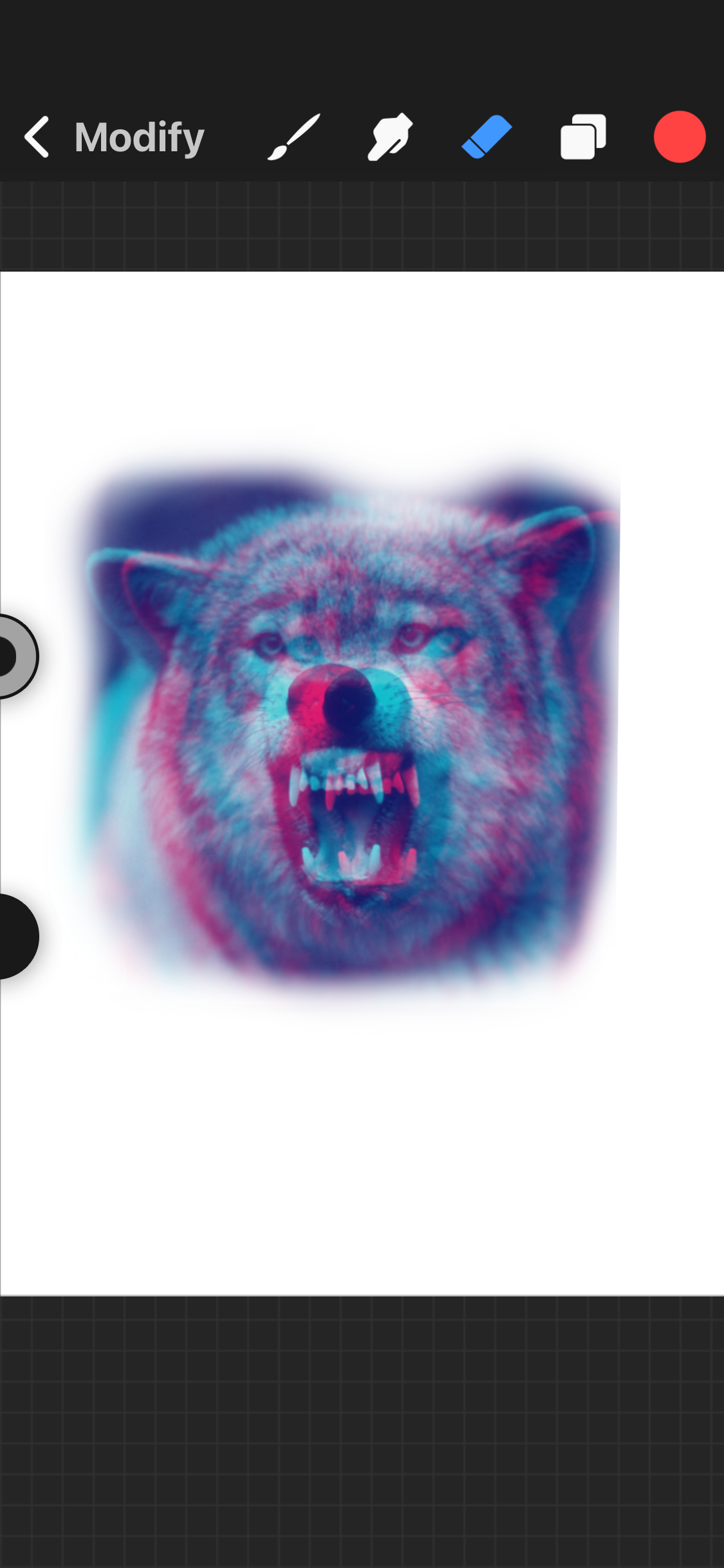
Around 2023, I started asking whether a photorealistic tattoo could have depth you actually see through 3D glasses. Shading already gives a tattoo the illusion of depth. I wanted to arrange two colored views so some details appeared in front of the skin and others behind it.
Where the idea started
The first spark came while I was collaborating with Jules Grace (Julia Hickerson). We used a chromatic-aberration effect in Procreate on a woman's portrait and decided to tattoo it. That experiment made me wonder whether the colors could be arranged to create functioning stereoscopic depth. Jules deserves credit for that original collaboration. I developed the stereoscopic photorealism approach further in my own designs.

What makes it stereoscopic?
Traditional realistic tattooing creates the impression of depth through lighting, contrast, perspective and shading. Stereoscopic photorealism adds binocular disparity. In an anaglyph image, red-and-blue or red-and-cyan filters separate slightly different views for each eye. Your brain combines them and interprets their horizontal differences as depth.
Simply putting colored outlines around a tattoo doesn't automatically make it stereoscopic. The relative positions of corresponding details have to be planned. With the correct separation, I can place one part of a composition in the foreground and another farther back, rather than pushing the entire image in one direction.
Depth in both directions
People tend to think of 3D art as something popping outward. I wanted more control. Some elements can seem to project from the skin while others appear to sit behind it. The tattoo itself remains on the skin; the perceived distance comes from how each eye receives the image through the glasses.
July 21, 2024: Kevin Reese's bomber-plane tattoo
I applied this approach to a back tattoo for my friend and repeat client Kevin Reese. Elijah Wells and I worked together on Kevin's back on July 21, 2024. The piece features bomber planes and falling bombs. In the photograph of us tattooing Kevin, Elijah is on the left and I'm on the right. The stereoscopic arrangement was intended to put the planes at different perceived distances instead of having them all occupy the same visual plane. This was a separate project from the earlier collaboration with Jules Grace.


Looking directly, in a mirror, or upside down
The glasses must be worn in the color arrangement used when the design was created. If you look at the tattoo directly and right side up, use that arrangement.
When you look at your own tattoo in a mirror, the reflection reverses left and right. That can invert the horizontal disparity, making a part intended to project outward appear to recede. Swapping which eye wears the red lens and which wears the blue lens can restore the intended front-to-back relationship, provided the filters match the artwork.
Viewing the tattoo upside down can cause a similar reversal. Rotating the image 180 degrees reverses its horizontal disparity relative to your eyes. Swapping the lenses can compensate for the depth inversion, though the result may look different because the picture itself is rotated.
For the clearest effect, view the tattoo directly, right side up, with the intended lens arrangement. If you're using a mirror or looking at it upside down, try swapping the lenses.
From photorealism to surrealism
The stereoscopic method isn't limited to photorealism. My digital experiments include a photorealistic snarling wolf, a foreshortened handgun and hand, and a surrealist female portrait. These are digital concepts, not photographs of finished tattoos. The early woman-and-castle tattoo made with Jules Grace (Julia Hickerson) is a completed surrealist tattoo, and that collaboration helped start the experimentation.
The effect can be applied to almost any kind of image, not just photorealism or surrealism. But being able to make an image work through red-and-blue glasses doesn't automatically make it a good tattoo. People will spend most of their time looking at it without the glasses, so the design still has to look good on skin in normal viewing. If the color separation makes the artwork muddy, distracting or difficult to read without the glasses, the 3D trick isn't worth sacrificing the tattoo itself.


Taking the design onto skin
I build these designs in Procreate, using photographic detail and carefully placed color separation. The placement has to survive the move from the screen to skin. A small shift in a colored detail can change how far forward or back that part appears.
I call the approach Stereoscopic Photorealism Tattooing. I did not invent stereoscopy or anaglyph images, and other artists have used red-and-blue effects in tattoos. My work focuses on applying controlled, bidirectional stereoscopic depth to photorealistic tattoo designs. As far as I know, this is my original application; this article documents its development and examples.
How the work developed
The collaboration with Jules Grace around 2023 started the experiment. By July 21, 2024, Elijah Wells and I were applying the approach to Kevin Reese's back, arranging the bomber planes and falling bombs at different perceived depths. In 2026, I began documenting the technique and showing the finished tattoos alongside the digital concepts.
Planning a stereoscopic tattoo
If you want to explore this approach, start your tattoo with your idea, placement and reference images. I work in Arlington, Texas, serving clients across Dallas–Fort Worth. We can look at whether the composition suits the effect and how it will read on skin with and without the glasses.


